
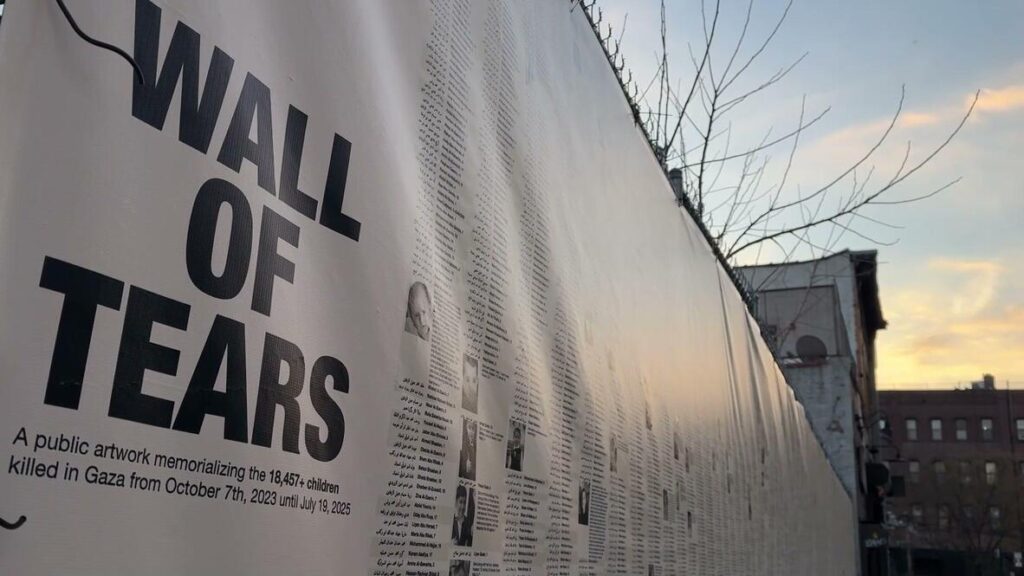
On Thursday, January 29, artist Phil Buehler unveiled his striking 50-foot mural, “Wall of Tears,” to the public in New York City. The installation serves as a memorial for the victims of the ongoing conflict in Gaza, prominently featuring the names of 18,457 children who lost their lives since October 7, 2023.
The names on the mural were sourced from publicly available data, primarily provided by Gaza’s Ministry of Health. Buehler explained:
“The first names are from October 7, 2023, and the most recent are from July, which is when the database was last updated.”
To bring the data to life, Buehler relied on tools like Excel, InDesign, and Photoshop, designing the mural with a detailed color-coding system: light tan for girls and darker tan for boys.
“It becomes a statistical art and design problem,” Buehler said. “There’s no other way to handle this much data and still search for the stories and faces behind it.”
The installation aims to capture public attention in the midst of a relentless news cycle.
“You almost get overwhelmed by the scale of it, to the point where you tune out. They’ll see the scale, but then they’ll walk up to one child, read their story, see their face, see their picture,” Buehler explained.
Revealed on the anniversary of the death of five-year-old Hind Rajab, the mural lists names in both Arabic and Latin script, ordered chronologically and gender-coded.
“Hind Rajab…she’s just one of 20,000,” Buehler noted. “As I was making the wall, I thought about each of them individually.”
Produced in collaboration with Radio Free Brooklyn (RFB), a nonprofit that supports underserved communities through media education and public storytelling, the project continues Buehler’s tradition of politically engaged public art. His past works include:
- Wall of Lies – listing over 20,000 lies told by Donald Trump
- Wall of Liars and Deniers – documenting 381 Republican election deniers from the 2022 midterms
- Wall of Shame – highlighting over 1,500 January 6 rioters
The “Wall of Tears” stands as a powerful visual reminder of the human cost of conflict, transforming overwhelming statistics into individual stories that demand attention, reflection, and empathy.